
Before I begin, a trigger warning. This blog post deals with child abduction and child abuse allegations.
I’ve blogged about research before and the dark and deep rabbit holes you can find yourself tumbling into. I only thought I had some sketchy search history for Enemies of Doves. A River of Crows was truly a different ballgame. I spent an entire night doing a deep dive into date rape drugs that don’t stay in your system long. So, that should give you an idea of all the watch lists I’m currently on.

Let me start by saying, I had two other book ideas and tabled both of them because I didn’t want to write a book that needed extensive research. A River of Crows is set in 1988 and 2008, so I naively thought I wouldn’t need to do much research. That is so funny to think about now, after six months of a disturbing and frustrating quest that ultimately ended with me contacting the FBI and changing major aspects of my plot.

This is a bit hard to blog about without giving any spoilers, so I’m going to be as general as possible when it comes to how any of this plays into my book.
The most pleasant research I got to do was about crows, and it was fascinating. I can’t wait for you to learn all the fun tidbits I did and see how I wove crows as a motif throughout the entire story.

The least enjoyable research I had to conduct was about missing children. The plot of my book revolves around a (fictional) boy who went missing in 1988. As a child of the ’80s I grew up in what I’ll call the “Stranger Danger” generation. (Also, the “Satanic Panic” generation, but I’ll get there in a bit). As a child, I feel like I was constantly told to look out for kidnappers. My mom used to tell me stories of how she’d ride her bike all over town as a kid, but now that was no longer safe. I remember rumors in my town about a red truck with a white stripe that a kidnapper drove. As a kid who played outside a lot, I remember that sense of panic every time I saw a truck matching that description drive by. I’d hide in the bush or run inside. When you are looking for something, it’s amazing how many times you’ll see it.

I also remembered several cases of missing children, but the details were vague in my mind… a missing paperboy, a child taken from a shopping mall, faces on milk cartons. So, I got to wondering, was there an uptick of child kidnappings in the ’80s? Was the media just fixating on it? Had the world suddenly gone mad? Were we really in grave danger?

I started by listening to a podcast called Faded Out hosted by Sarah DiMeo about the kidnapping of Johnny Gosch, a 12-year-old paperboy in 1982. His case is so fascinating for many reasons. For one, it remains unsolved, and there are SO many conspiracy theories out there about it. This podcast went deep into all of them. Johnny’s parents are divorced and the father believes (as the podcast host did by the end of her research) that Johnny was taken by a pedophile and likely killed that same day. The mother believes Johnny is still alive and was a victim of a far-reaching, powerful child pedophile ring. She claims Johnny showed up at her door as an adult, told her these things, and then walked away into the night never to be seen again. I just can’t stress how crazy a story this is and how deep some of these conspiracies go, but basically it involved allegations against some of Omaha’s more prominent citizens and stretched all the way to top officials at the White House (George Bush Sr). Ultimately, a grand jury found that the rumors of this pedophile ring was an elaborate hoax, but there are many out there on the web who still fully believe it. There were times I was unsure, but after hearing everything, I tend to agree with the father and podcast host, but I’m not a conspiracy person in general either.

Another defining aspect of the ’80s was the rise of Satanic Panic. Everything in the ’80s was said to have ties to satanism. Lyrics played backwards, shampoo logos, even the drumbeats of Christian rock music could summon demons. Satanists were poisoning Halloween candy. (There was one lone case where Halloween candy was poisoned, and it was a father killing his son for an insurance scheme. All the rest are urban legends.)

When it came to children, there were wide spread allegations of satanic ritual abuse in the ’80s. I listened to and read tons of crazy stories that children shared about parents and daycare workers abusing them and performing satanic rituals on them. Just crazy, insane stories. The mantra then was understandably, “Always believe the children.” Because WHY would any child make something like this up? Well, almost every story I found involved a child being coerced by a therapist, prosecutor, or parent in a divorce proceeding. Satanic panic basically started with a discredited memoir from the ’70s and spread like wildfire, leading to a modern-day witch hunt.

Think about the ’80s, a time of economic growth where, in many households, both parents worked, necessitating an increased need for daycares. Many feared this was the end of the nuclear family and thus daycares became a popular target of satanic ritual abuse allegations. Don’t people always fear change and the unknown?
Many people’s lives were ruined because of false allegations. Simply put, almost all incarcerated individuals accused of satanic ritual abuse have since been exonerated. It was true mass hysteria. In 1992, the Department of Justice thoroughly debunked the myth of the ritualistic satanic sex abuse cult, talk show hosts and journalists apologized, but the damage was done. To this day, many people still don’t know the truth. In fact, many of these theories are beginning to circulate again, but I’m not gonna touch that right now.
The last child kidnaping case I decided to really delve into was Jacob Wetterling, an 11-year-old boy kidnapped and murdered in 1989. His case was solved after 27 years, largely thanks to a blogger. The Wetterling abduction led to the establishment of the sex offender registry. I began listening to a truly fantastic podcast called In the Dark about this case.

In all my podcast listening and hours of readings, it seemed that most claims of elaborate pedophile rings of the ’80s were debunked, and in most of these infamous cases, it was an individual acting alone who kidnapped, abused, and usually quickly disposed of their victims.
I still wanted to know, were the kidnapping numbers up in the ’80s? I found several articles that claimed it was just awareness that went up, and the number of children kidnapped was very, very small. WHAT? That seems to go against everything we hear about concerning child kidnappings. So, I started looking for the actual numbers of kidnapped children, and I couldn’t find anything except articles saying that in a vast majority of cases, missing children are runaways that return home within a very short amount of time. I read over and over that stranger kidnapping is extremely rare in the USA. Almost all missing children reported in our country are supposedly recovered.
Still, I needed to see the stats on this. Sex trafficking is a huge industry. I mean, we can’t go on Facebook without reading a story that happened in a Walmart of someone trying to take a child. I have had a terrifying personal experience with this with my youngest child in our own front yard.
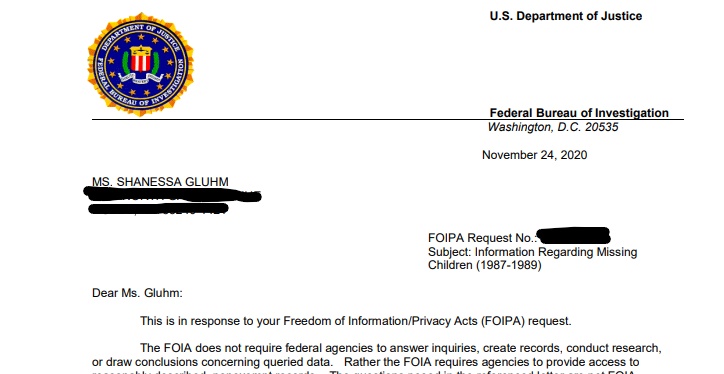
I ended up on the FBI site and couldn’t find the numbers, but I did find something else, a way to request information from on them. So, I did. I filled out a request asking for the numbers of missing children for the years in which my book is set.

While I was doing this, I was still listening to the Jacob Wetterling podcast and halfway into episode six, my mouth dropped open. They too were seeking out numbers for children kidnapped then vs. now. They were curious if the sex offender registry has actually decreased kidnappings. Like me, they assumed the FBI must have numbers on this, that surely, they do some sort of yearly report. They requested this information and were denied. They tried again and were contacted by what is called a FOIA (Freedom of Information Act) negotiator. She eventually told them the information was spread out in boxes that would be too hard to gather. They requested access to the boxes themselves and were denied.
I got a similar response from the FBI. They denied my request basically saying that I can’t ask that the FBI conduct research. In other words, they have no numbers compiled to give me.
And as I learned by the research done by Madeline Baron and her team on the podcast, there are still no numbers they could give us for recent years. Local law enforcement agencies are not required to do any reporting to the FBI about missing children. What she did find is that Congress requires the Justice Department to do periodic national incident studies about how many children are missing and how many are recovered, but in the past 30 years, they have only done two.
Luckily for me, one of those years was 1988. (What are the odds?) However, this report only surveyed 83 agencies and estimated that 200-300 missing children reports were stranger abductions. They did the same study in 1999 and surveyed over 4000 agencies. They estimated that there were about 115 stranger kidnappings that year.
In both studies, the vast majority of missing children were runaways or children missing for benign reasons (miscommunications, sneaking out to see a friend, etc.). Only 7 percent were family abductions and only 2 percent were non familial abductions.
You really can’t compare these two years because they used different methods of counting and the federal government actually says they should not be compared. So, in short, the FBI has no record of how many children are kidnapped year by year and whether the numbers are going up or down.

As Madeleine stated on her In the Dark Podcast, “Will and I spent 6 months researching this, and in the end, we came up with almost no data on what lawmakers, the media, and pop culture have led us to believe is one of the worst threats facing children in this country.“
This is just bizarre to me that in this day and age that this information can’t be tracked and compiled. Obviously, one child is too many, and it’s important we know about about any missing child regardless of the reason so we can keep an eye out, but if the numbers for stranger adductions are so small why are we so preoccupied with the idea of stranger danger as a culture?
I had no doubt these numbers had risen by 2020 due to the rise in human trafficking, so I tried to do some research on that, but again, it’s all estimates. Because of the hidden nature of trafficking, it’s hard to gather reliable statistics. But I found that cases of kidnapping in human trafficking operations are relatively rare. More often, victims are coerced or forced into trafficking through familial or romantic relationships. I also learned the majority of trafficking victims are adult women and that half of trafficked children are sold for a few hours at a time by a family member for money or drugs. It’s not always like the movies portray, and that’s often why we overlook so many victims in plain sight.
According to the International Centre for Missing and Exploited Children, an estimated 460,000 kids go missing in America now each year. But that again is only an estimate. They acknowledge that the statistic is inaccurate and not enough information is known. For instance, are only 2 percent of those actual stranger kidnappings as was the case in 1999? In short, they have no idea.
The National Center for Missing and Exploited Children probably has the most up to date information I could find, but many of their numbers rely solely on calls to their tip line. They do acknowledge that nonfamily abductions are the rarest type of case and make up only 1% of the missing children cases reported to them.
Are all these estimates and calls into a hotline the best we can do for tracking these cases? Isn’t a nationwide framework overdue? When I told my husband that I contacted the FBI, he said, “Why would you do that? You know you are already on their watch list.”
So, FBI Agent reading this post, please look into this. Surely we can do better.

Is anyone else surprised by these numbers or lack of numbers? As I said, it really changed the course of my book, but you’ll have to wait till it comes out for more information on that.

 Shanessa Gluhm
I’ve looked a lot into your blog!! And I think its awesome you are an author!!!!! I want to maybe be one too when I get older I’m already working on two books not many people know XD
LikeLiked by 1 person
Thanks, Shanessa. (It feels weird to write that).
That’s exciting! What kind of books do you write?
LikeLiked by 1 person
Haha, I bet! I still think its so funny we both have the same name😂 well, I like writing books that deal with my thoughts on things and sometimes my feelings. And mysteries!!
LikeLiked by 1 person
My goodness, what a lot of research you have done. It’s really too bad that kids can’t go out and just run around like we used to.
Best of luck with your second book.
Happy Holidays.
Susan
LikeLiked by 1 person